A luxury villa is more than a large house with expensive furniture.
Walk into a truly well-designed villa, and you notice something different. The spaces feel calm. The lighting feels effortless. Materials complement each other. There is enough openness to breathe, yet every corner has a purpose.
That is where luxury villa interior design ideas have been trending in Trivandrum.
Homeowners are increasingly moving away from interiors that simply look expensive and towards spaces that feel warm, personalised, timeless and connected to the way they actually live. Across Kerala, warm minimalism, natural materials, earthy colours, indoor-outdoor connections and personalised detailing are becoming increasingly prominent in residential interiors.
For a luxury villa in Trivandrum, however, international trends cannot simply be copied from a magazine. Kerala’s tropical climate, strong natural light, monsoons, local materials and cultural character all influence how an interior should be designed.
Here are some of the luxury villa interior design ideas worth considering for your home in Trivandrum.
For years, luxury interiors were associated with glossy surfaces, stark white walls, oversized chandeliers and excessive decoration.
That idea is changing.
One of the strongest directions in contemporary Kerala interiors is warm minimalism — clean architectural lines combined with natural textures, warm wood, subtle colours and carefully selected furniture.
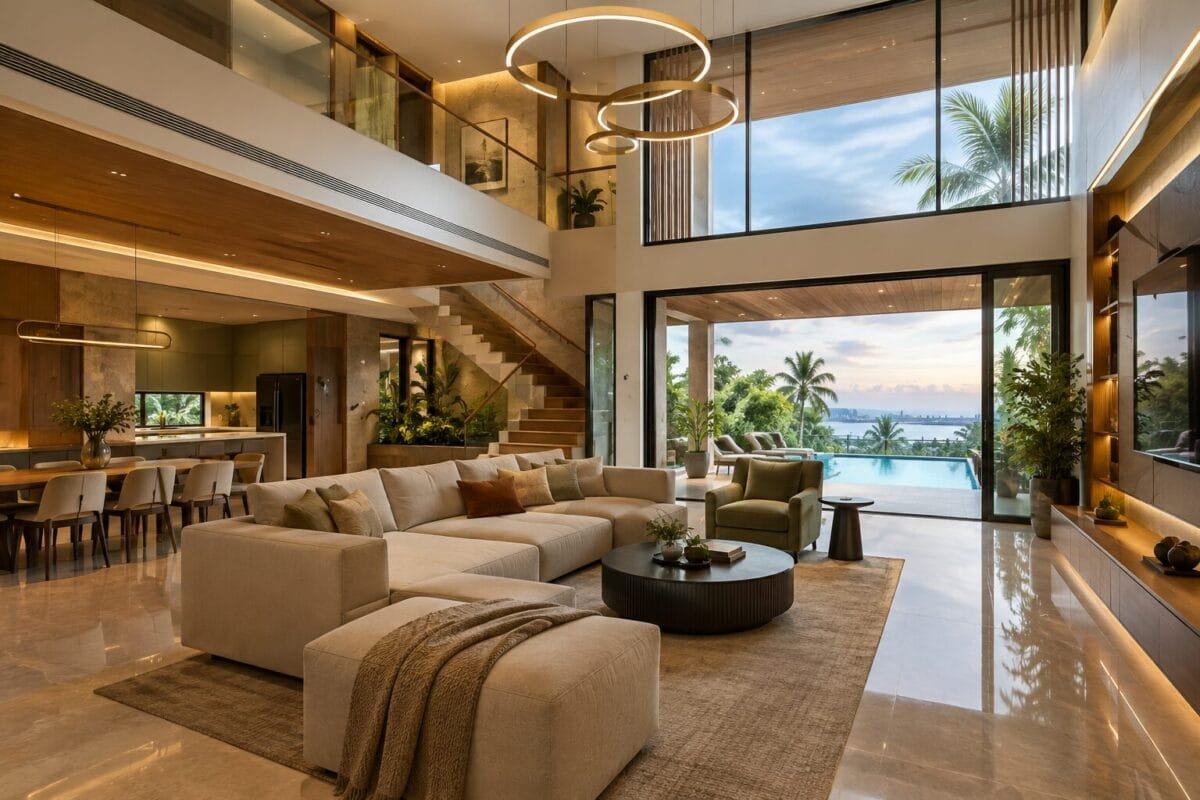
Think of a living room with:
The luxury comes from proportion, craftsmanship and material quality, rather than filling every available surface.
For villas in Trivandrum, this approach also works beautifully with Kerala’s natural light. Warm neutrals can make sunlight feel softer and more inviting, while wood and stone introduce visual warmth.
Instead of asking, “What expensive elements can I add?”, ask:
“What can I remove while making the remaining elements better?”
That simple shift can completely change the character of a luxury interior.
There is something timeless about walking into a home where you can actually feel the material.
Wood has always had a strong place in Kerala architecture, and contemporary villa interiors are bringing it back in more refined ways.
Teak, natural wood finishes, stone, cane and other tactile materials are increasingly being used for feature walls, furniture, ceilings, partitions and architectural details.
In a Trivandrum villa, natural materials can be introduced through:
The goal is not to use every natural material at once.
A beautiful interior often comes from choosing two or three dominant materials and repeating them intelligently throughout the house.
This creates continuity between the living room, dining area, bedrooms and circulation spaces.
Luxury villas often have generous floor areas. The challenge is making those large spaces feel intimate rather than empty.
Open-plan living continues to be popular in Kerala, particularly where the living, dining and kitchen areas can visually connect. But modern luxury design is becoming more sophisticated about how these spaces are divided.
Instead of building unnecessary walls, designers can use:
For example, a large living room can have a formal seating area near the entrance, a more relaxed family seating zone towards the garden and a dining space connected visually to both.
The result is an open home that still feels organised.
Trivandrum has a natural advantage when it comes to biophilic design.
Why hide the greenery outside when the architecture can frame it?
Large windows, courtyard views, internal gardens, balconies and landscaped sit-outs can create a seamless relationship between the villa and its surroundings. Biophilic design is also increasingly being incorporated into Kerala homes through plants, natural light, outdoor rooms and nature-inspired materials.
Imagine waking up to a bedroom overlooking a private garden.
Or having a dining area opening towards a landscaped courtyard.
Or sitting in the living room during a Kerala monsoon while the garden becomes part of the interior experience.
That is luxury that cannot be bought from a furniture catalogue.
When planning your villa interiors, don’t only show your designer pictures of furniture you like.
Show them:
the garden, the views, the sunlight and the way your family uses the house.
These can become part of the design itself.
A beautiful interior can lose its charm completely under a single bright ceiling light.
Luxury villas increasingly use lighting as part of the architecture rather than simply as illumination.
A layered lighting scheme may combine:
General illumination that makes the room comfortable and functional.
Used to highlight artwork, textured walls, architectural elements or furniture.
Pendant lights, chandeliers, sculptural fixtures and floor lamps that contribute to the visual identity of the room.
Natural and tactile lighting fixtures are also gaining attention as interiors move towards warmer, character-rich aesthetics.
In a luxury villa, lighting should also be planned according to how the room changes throughout the day.
Morning light.
Afternoon sunlight.
Evening conversations.
Late-night relaxation.
The same room should feel different at each of these moments.
Neutral does not have to mean boring.
Luxury interiors in Kerala are increasingly incorporating warm whites, beige, terracotta, muted greens, earthy browns and natural wood tones rather than relying entirely on cold grey-and-white palettes.
For a sophisticated Trivandrum villa, consider combinations such as:
Warm white + teak + olive green
Beige + walnut + brushed brass
Terracotta + cream + natural stone
Soft grey + wood + muted green
The important thing is balance.
If everything is a statement, nothing becomes a statement.
Luxury is not necessarily about buying the most expensive sofa available.
Sometimes it is about having a sofa designed specifically for your living room.
Custom furniture allows the proportions, materials, colours and functionality to respond to the architecture.
A long wall could accommodate a custom TV console with concealed storage.
An awkward corner could become a reading nook.
A large master bedroom could have a customised upholstered bed wall with integrated lighting.
A double-height living room could accommodate furniture scaled specifically to the volume of the space.
This is where experienced interior designers can make a significant difference: the furniture becomes part of the architecture rather than something placed inside it.
The kitchen is no longer necessarily a room that needs to be hidden.
In contemporary villas, the kitchen can become an extension of the home’s design language.
A luxury kitchen in Trivandrum may combine:
For families who entertain frequently, the relationship between the kitchen, dining area and living space becomes particularly important.
The design should consider not only how the kitchen looks in photographs, but how people actually move through it during everyday life and when guests arrive.
One beautifully finished wall can often have more impact than ten decorative elements.
Textured plaster, natural stone, wood, microcement-style finishes and other tactile surfaces are being used to give luxury interiors depth and character. Current interior design conversations increasingly emphasise layering textures rather than simply adding more decoration.
For example, a living room could have:
Each element contributes a different texture.
Together, they create richness without visual clutter.
Perhaps the most important trend is one that cannot really be called a trend.
People want their homes to feel like their own.
A luxury villa should tell you something about the people living there.
Maybe there is a library because someone in the family loves reading.
Maybe a particular artwork reminds them of a place they travelled to.
Maybe a traditional Kerala element has been reinterpreted in a contemporary way.
Maybe the dining area was designed specifically around long family dinners.
These details make a house memorable.
The strongest contemporary Kerala interiors are increasingly moving towards personalised spaces rather than interiors that look like showroom packages.
There is one important point that should never be overlooked.
A beautiful interior designed without considering Kerala’s climate can become a maintenance headache.
Trivandrum experiences high humidity, strong sunlight and heavy monsoon conditions. Material selection, ventilation, moisture resistance, cleaning requirements and natural-light control should therefore be considered from the beginning.
For example:
Luxury should feel effortless after the house is completed — not require constant effort to maintain.
Finding the right team is about more than looking at attractive Instagram renders.
Before selecting an interior design company, look at:
Have they worked on villas similar in scale and style to yours?
Do they understand local materials, climate, construction practices and lifestyle?
Do they explain the concept, material selection, drawings, 3D visualisation and execution process clearly?
Are you receiving a genuinely customised design or a standard package?
A beautiful 3D render means very little if the execution cannot match it.
If you are searching online for the best interior designers in Trivandrum, compare portfolios, design approach, project experience, communication and execution quality rather than choosing purely based on photographs.
Warm minimalism, natural materials, earthy colour palettes, personalised furniture, layered lighting and indoor-outdoor connections are among the prominent directions in contemporary Kerala villa interiors.
Focus on proportion, lighting, material quality, custom furniture and a restrained colour palette. A few high-quality architectural elements generally create more sophistication than excessive decoration.
Yes, provided they are selected and detailed appropriately for Kerala’s climate and maintenance conditions. Wood, stone, cane and other natural materials can add warmth and character when used thoughtfully.
Trends can provide inspiration, but they should be adapted to your home’s architecture, Kerala’s climate, available materials and your family’s lifestyle. The goal should be a home that remains beautiful beyond a particular trend cycle.
The cost can vary significantly depending on the villa’s size, design scope, materials, custom furniture, finishes, lighting, automation and execution requirements. A detailed project brief and site assessment are usually necessary before giving a meaningful estimate.
Discuss your lifestyle, space requirements, preferred design style, budget, timeline, material preferences, storage requirements and expectations regarding design and execution. Sharing references is helpful, but the final design should be adapted to your home.
The best luxury interiors are rarely the ones that simply follow every trend.
They are the ones where architecture, materials, light, furniture and landscape come together naturally.
For a villa in Trivandrum, that could mean combining contemporary minimalism with the warmth of Kerala’s natural materials. It could mean framing a garden through a floor-to-ceiling window, creating a quiet reading corner beside a courtyard, or using traditional craftsmanship in a distinctly modern way.
Ultimately, luxury is not about making your home look expensive.
It is about making it feel considered, comfortable, personal and timeless.
If you are planning a new villa or transforming an existing home, Build Art Interiors & Constructions approaches residential interiors with a focus on design, functionality, material selection and detailed execution.
Looking for premium interiors in Trivandrum? Talk to Build Art about creating a villa interior designed specifically around your space, lifestyle and vision.
Build Art Interiors & Constructions — Turning spaces into experiences.