When you walk into a beautifully designed home, the ceiling may not be the first thing you notice. Yet it can completely change how a room looks and feels.
The right false ceiling design can make a living room feel spacious and elegant, create a relaxing bedroom atmosphere, improve lighting, and neatly conceal electrical wiring and other services.
For modern homes in Kerala, ceiling design needs to go beyond appearance. Humidity, monsoon conditions, ceiling height, ventilation, room size, and maintenance all matter.
Whether you are building a new villa in Trivandrum, renovating an apartment, or designing a contemporary Kerala home, the goal should be simple: create a ceiling that looks beautiful today and continues to work well for years.
Let’s explore some practical and stylish false ceiling design ideas for modern Kerala homes.
A ceiling is an important part of the interior composition.
It connects the walls, lighting, furniture, and other architectural elements. When planned properly, it can also visually divide different zones without using physical walls.
For example, a floating ceiling above a dining table can make the dining area feel separate from an open-plan living room. A simple cove ceiling can make a bedroom feel warmer in the evening.
There is also a practical advantage.
False ceilings can conceal wiring, lighting components, AC-related services, and other installations, creating a cleaner appearance.
For homeowners in Trivandrum, this is particularly useful when designing modern apartments and compact urban homes where every visual detail matters.
If you are working with a smaller space, our guide to small home interior design ideas for Kerala homes may also help you plan the ceiling alongside furniture, storage, and lighting.
One of the safest options for a contemporary Keralan home is minimalism.
Without making the space feel crowded, a straightforward gypsum ceiling with neat borders and thoughtfully placed lighting can create a sophisticated appearance.
This kind of false ceiling design is especially effective in:
The biggest advantage is timelessness.
A ceiling does not have to follow every interior trend. A simple design can continue looking relevant even when furniture and decor change.
If your living room already has a feature wall, statement furniture, or decorative flooring, keep the ceiling relatively simple. Good design often comes from knowing what not to add.
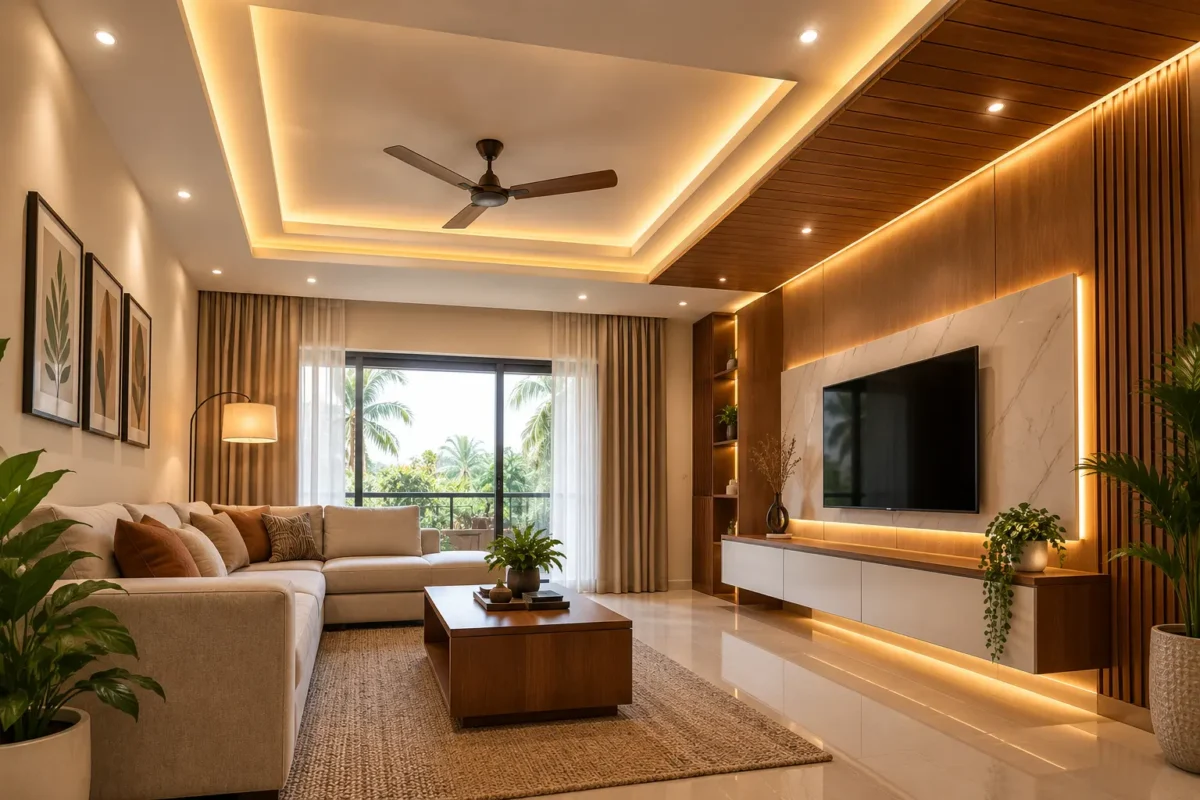
Cove lighting is one of the most popular false ceiling design ideas, helping create a warm, premium atmosphere.
LED strips can be hidden in a recessed part of the ceiling, so the light is gently diffused rather than blasting into the room.
This gives off a warm glow, which is particularly nice in the evenings.
In a Trivandrum living room, you might blend warm cove lighting with recessed spotlights. Cove lighting creates ambience, and spotlights provide functional illumination.
The same strategy works wonderfully in bedrooms.
Instead of one bright centre light, several layers of softer light can make the room much more relaxing.
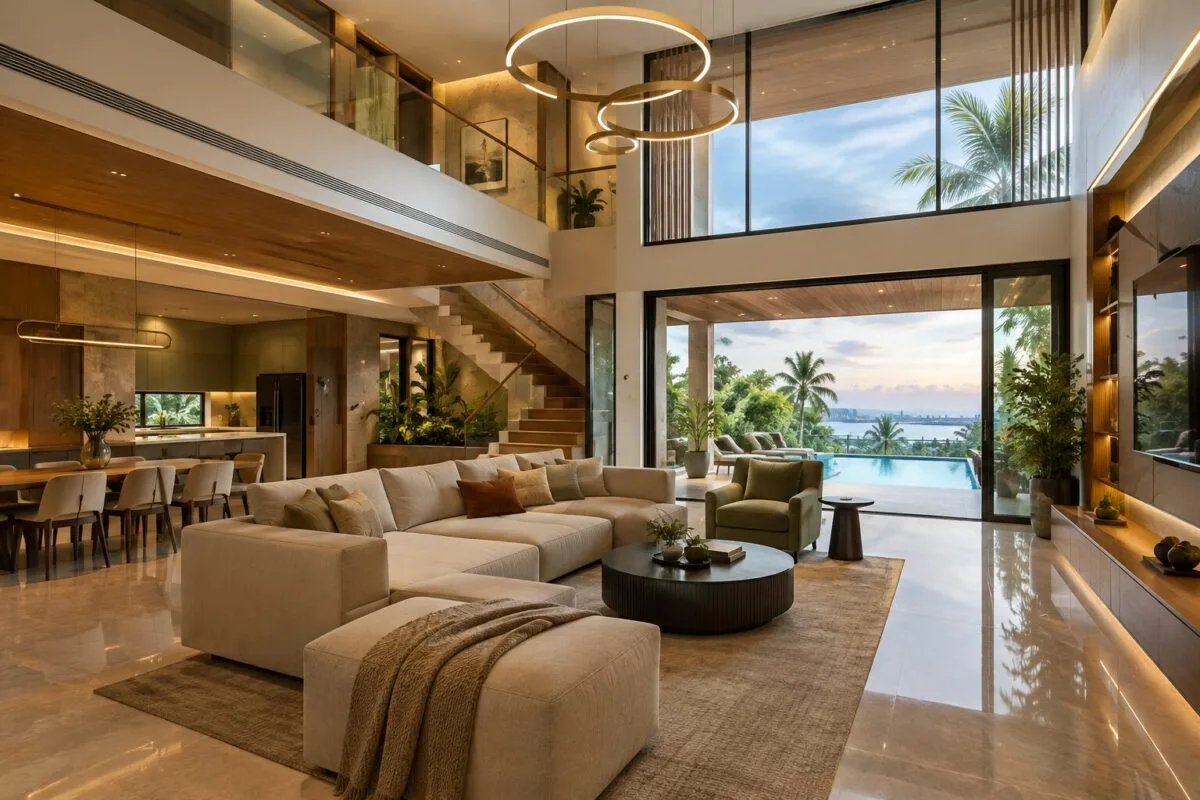
A floating ceiling gives the illusion that a portion of the ceiling is suspended beneath the main slab.
LED lighting around the edges enhances this effect.
This contemporary ceiling design is especially effective in larger living rooms, villas, and double-height spaces.
It can also help define a specific zone.
Consider an open-plan living and dining area. A floating ceiling above the dining table can visually separate the dining area without the need for a wall or partition.
This gives the home a more open feel while maintaining visual structure.
Wood has traditionally held a special place in Kerala architecture.
Traditional homes made extensive use of timber, and modern designers can reinterpret that warmth with contemporary wooden ceiling accents.
Instead of covering the entire ceiling in wood, consider using:
A wooden accent above a dining table or seating area can immediately make the room feel warmer.
It also works well when combined with white or neutral gypsum surfaces.
The result is a balance between traditional Kerala character and modern interior design.
If you have a spacious villa with sufficient ceiling height, a layered gypsum ceiling can add depth and architectural character.
Different levels can be used for concealed lighting, recessed spotlights, or decorative elements.
However, more layers do not automatically mean more luxury.
A common mistake is copying an elaborate ceiling from a large luxury home and installing it in a smaller room.
The proportions may not work.
The ceiling should always respond to the room’s size, height, and furniture arrangement.
A well-designed single- or double-level ceiling can look far more premium than an unnecessarily complicated design.
A tray ceiling is one where the centre section of the ceiling is set in, and the perimeter is raised.
It adds depth without getting too decorative.
A tray ceiling can be particularly effective in a master bedroom.
The central area can be kept simple with a border around it that has some subtle LED lighting.
In a larger living room, a pendant light or chandelier can be used in the centre area to create a centre point.
This type of design is great if you want something more interesting than a flat ceiling but still want a clean, contemporary look.
For homeowners who prefer a more expressive interior, geometric ceiling patterns can add personality.
Rectangles, linear grooves, offset panels, and asymmetrical forms can create a distinctive modern look.
But there is one important principle:
The geometry should have a purpose.
Ceiling lines should ideally align with the furniture or architecture.
For example, a rectangular ceiling detail can follow the shape of a dining table. Linear elements can visually connect with a TV wall or passage.
When ceiling geometry follows the room’s layout, the entire interior feels more intentional.
Sometimes the best false ceiling design is the one that silently supports everything else.
This method works well, especially in smaller Trivandrum flats.
A slim ceiling profile with recessed downlights can make the space feel neat and tidy.
The best way is when the room already has strong visual elements, such as:
Rather than competing with these elements, the ceiling serves as a subtle background.
This can also help maintain the visual sense of height in smaller homes.
A false ceiling and a statement pendant can work beautifully together.
For example:
Living room: Cove lighting + recessed spotlights + pendant
Dining room: Linear ceiling detail + pendant above the table
Bedroom: Soft cove lighting + bedside lighting
Planning is the key.
The lighting points need to be fixed before starting the ceiling work. The position of the lights should be determined by the position of the dining table, sofa, bed, and other furniture.
This solves a common problem of a beautiful ceiling being finished, but the pendant being slightly off-centre from the furniture.
One of the most intriguing approaches for Kerala homes is to blend contemporary forms with subtle traditional influences.
A clean gypsum ceiling can be accented with timber-inspired details.
A modern living room can incorporate natural textures and warm lighting that are reminiscent of traditional Kerala homes.
You do not need to recreate an old-style Kerala house.
Instead, take the characteristics that distinguish Kerala architecture—natural materials, warmth, proportion, shade, and connection to the environment—and reimagine them for modern life.
For more inspiration, check out Build Art’s guide to modern Kerala house design.
Design is only one part of the decision.
The material also needs to suit the location and environmental conditions.
Gypsum is the preferred material for modern residential ceilings due to its smooth finish and compatibility with modern shapes, recessed lighting, and clean detailing.
Suitable for many living rooms, bedrooms, dining rooms, and other interior spaces.
POP (Plaster of Paris) is flexible for decorative and custom designs.
This is helpful for curves, mouldings, and more detailed ceiling pieces.
PVC ceiling systems may be considered in certain areas where moisture exposure is a concern.
The appropriate material is determined by the room’s moisture conditions, design specifications, and maintenance expectations.
Proper installation is as important as the material itself.
Treating lighting as an afterthought is one of the biggest errors made by homeowners.
You should develop your lighting plan and false ceiling design simultaneously.
Multiple lighting layers are typically beneficial for a good room.
Provides general illumination.
Provides focused light for activities such as reading, cooking, or working.
Highlights artwork, feature walls, or architectural details.
Creates soft, indirect illumination and improves the mood of the room.
The combination of these layers can make a home feel significantly more sophisticated than simply installing a bright central light.
Kerala’s climate makes practical planning especially important.
Never use a false ceiling to hide an existing water leakage problem.
Roof or plumbing issues should be resolved first. Moisture can damage ceiling materials and finishes.
A multi-level ceiling may look impressive in a large villa, but make a low room feel smaller.
For apartments and compact houses, minimalist designs are often a better choice.
Decide the positions of:
Before installation begins.
Concealed components may eventually require servicing.
Make sure important electrical and lighting components remain reasonably accessible.
A luxurious ceiling is not always a complicated ceiling.
Sometimes a single clean profile with beautiful lighting can make a much bigger impression.
Since every project is unique, there is no set cost for a false ceiling design.
The ultimate price may vary depending on:
Naturally, a multi-layered ceiling with customised features and integrated lighting will require more work than a simple gypsum ceiling.
Before deciding on your budget, it is helpful to comprehend the overall cost of interior design in Trivandrum if you are planning an entire interior project.
Verify what materials, lighting, finishing, and execution work are truly included in quotes rather than comparing them solely on price.
Before choosing a design from Pinterest or Instagram, ask yourself a few questions.
How high is the room?
A design that works in a high-ceiling villa may not work in a compact apartment.
What is the furniture layout?
The ceiling should complement the position of the sofa, dining table, bed, and other major elements.
How much lighting do you need?
Think about ambient, task, and accent lighting before finalising the ceiling.
What is the overall interior style?
The ceiling should support the furniture, flooring, walls, and architectural character.
How much maintenance are you comfortable with?
A visually complex ceiling may require more attention than a minimalist one.
The best design is the one that balances all of these factors.
Yeah. A well-designed false ceiling is a great addition to Kerala homes. But when selecting the materials and methods of installation, it is necessary to consider humidity, ventilation, exposure to moisture, and possible leakage.
Minimal gypsum ceilings, cove lighting, floating ceilings, tray ceilings, and simple geometric designs are popular choices. The best option depends on room size, ceiling height, furniture layout, and overall interior style.
Gypsum can be suitable for many indoor spaces in Kerala when installed correctly. Areas exposed to moisture require appropriate material selection and proper protection.
Yes. A false ceiling occupies some vertical space, although the amount depends on its design and the services being concealed. Low-ceiling rooms generally benefit from simpler, slimmer designs.
Yes. False ceilings are excellent for integrating recessed downlights, concealed LED strips, spotlights, and other lighting systems.
Start with the room dimensions, ceiling height, furniture layout, and lighting needs. Instead, choose a design that blends in with the rest of your interior, rather than making the ceiling a feature in its own right.
The best false ceiling design is not necessarily the most elaborate one.
It is the design that makes the room feel balanced.
For one Kerala home, that might be a warm cove ceiling in the living room. For another, it could be a minimalist gypsum profile with recessed lighting. A larger villa may benefit from a floating ceiling, while a compact Trivandrum apartment may look better with a simple, clean design.
Good interior design is about understanding these differences.
At Build Art Interiors & Constructions, Trivandrum, we believe that architecture, interiors, lighting, and construction should work together from the beginning.
A ceiling should not be designed in isolation. It should respond to the architecture, furniture, lighting, lifestyle, and character of the home.
If you are planning a new home, renovation, or interior project in Trivandrum, speak with a design team that understands both contemporary interiors and the practical realities of Kerala homes.
Your ceiling is above you every day. With the right planning, it can quietly make the entire home feel better.
Explore Build Art’s interior design insights and get in touch with Build Art Interiors & Constructions to discuss your project.